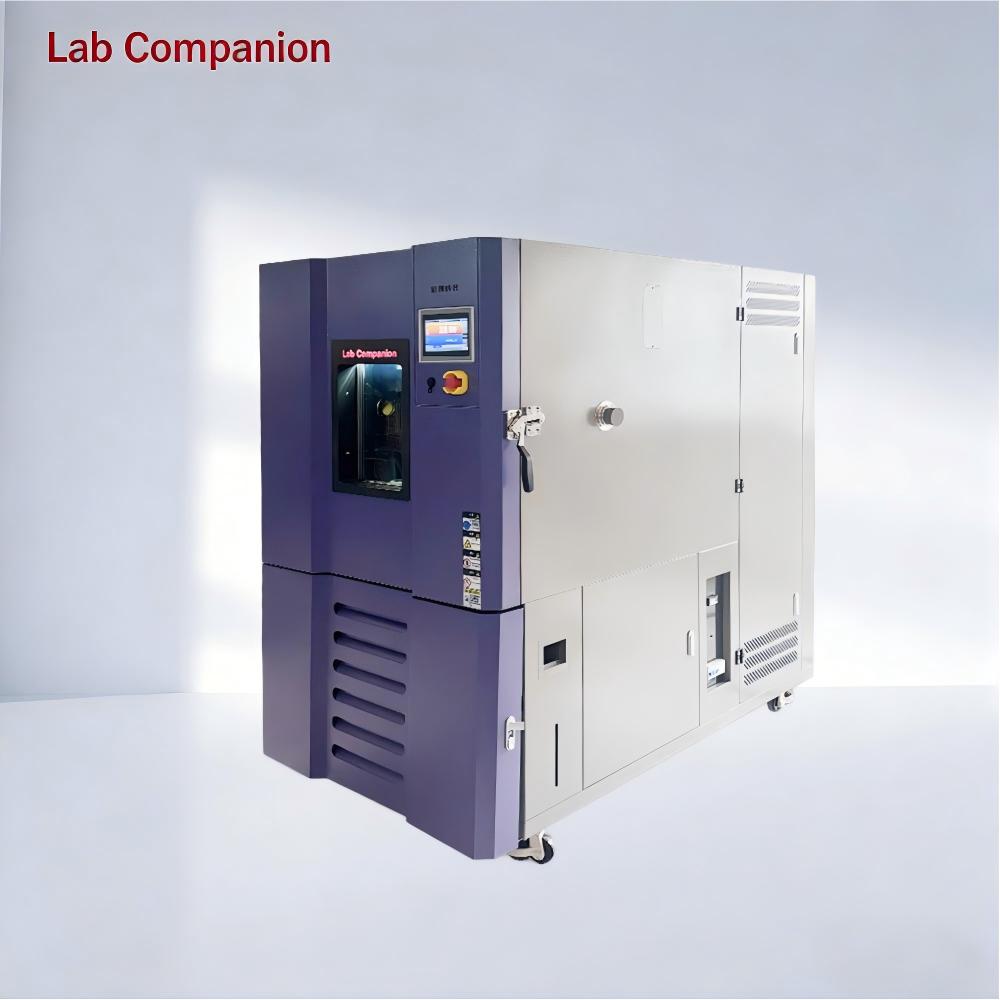
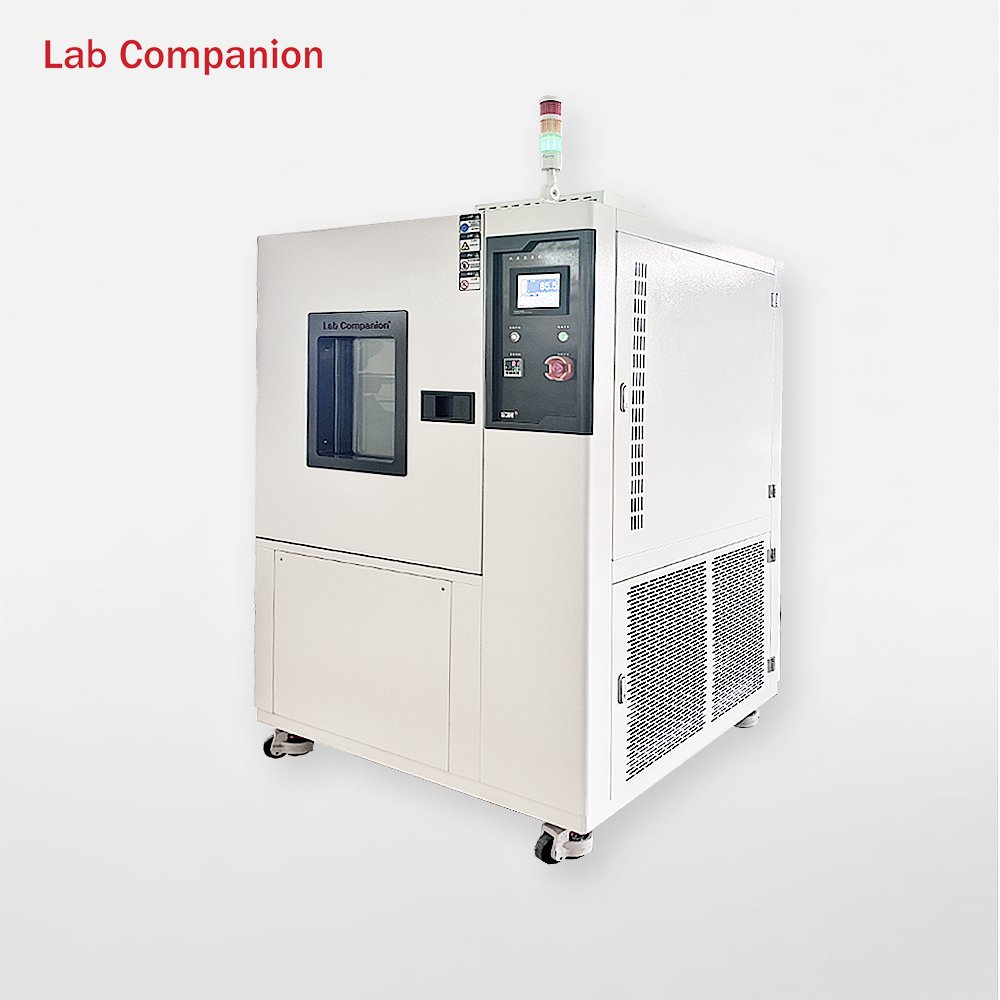
In the military and aerospace sectors, product reliability is directly tied to national security and the success of space missions. From missile guidance systems and satellite communication modules to airborne radar and spacecraft electronic cabins, such equipment endures extreme temperature shocks and complex environmental stresses during service. To eliminate early product defects before launch and prevent field failures, Environmental Stress Screening (ESS) is an indispensable process. Accordingly, the rapid temperature change test chambers used for ESS must first undergo rigorous reliability qualification.
With over 20 years of expertise in environmental and reliability test equipment, Lab Companion adheres to military-grade quality standards and full-process compliance systems, acting as a rigorous verifier of high-reliability rapid temperature change test chambers for national defense, military and aerospace applications. The company operates in accordance with ISO 9001, ISO 14001, ISO 45001 and ISO 27001 management systems, and all products hold CE certification. Its global clients cover core industries including aviation, aerospace, ordnance, shipbuilding, nuclear power, communication and electronics.
1. Inherent Reliability: Self-Stress Screening for Every Unit
Military and aerospace clients trust our equipment based on a core principle: a screening chamber designed to expose product flaws cannot deliver credible test data if it suffers frequent malfunctions, temperature overshoot or unstable temperature change rates.
Lab Companion integrates this self-verification philosophy throughout the entire product lifecycle. Every rapid temperature change test chamber undergoes full-load aging testing before delivery, simulating the harshest on-site operating conditions to ensure long-term stable performance from day one.
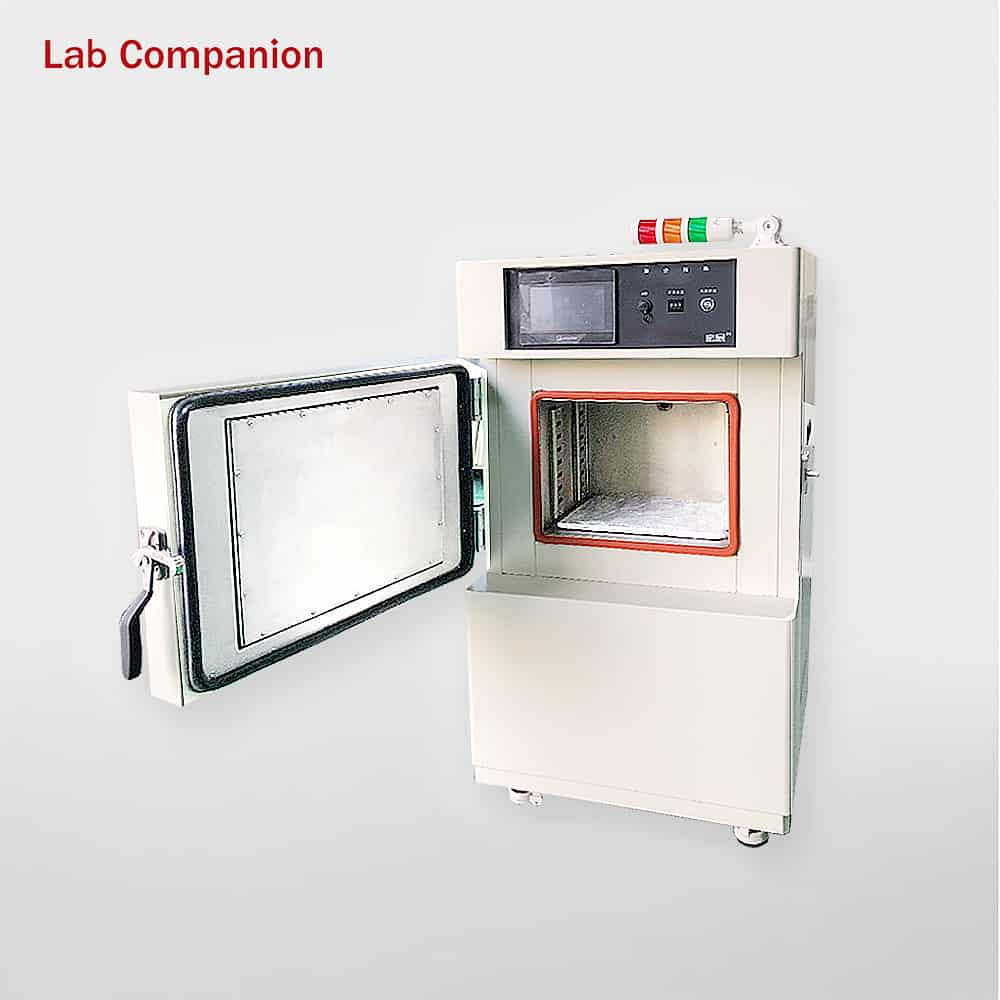
The TC Series offers a test volume ranging from 270L to 1300℃, with a temperature range of -70℃ to +180℃, meeting screening requirements from component level to complete equipment level. It supports linear temperature change rates of 5℃/min, 10℃/min, 15℃/min and up to 20℃/min, with temperature fluctuation controlled within ±0.5℃, delivering accurate and stable data for military and aerospace testing.
2. Comprehensive Safety Protection System
Military and aerospace tests involve high-value samples and extreme operating conditions, making equipment safety critical to test success. Lab Companion rapid temperature change test chambers are equipped with a full-dimensional safety protection system to secure all test operations.
Hardware-based independent protection includes dedicated over-temperature protectors, mechanical pressure switches and thermal relays, which cut off hazardous circuits within milliseconds independent of software control. The compressor is protected against overpressure, overload, high exhaust temperature and frequent startup via delay control. The heating system adopts dual over-temperature protection and anti-dry-burn design to isolate heating circuits automatically even if the main controller fails. These redundant safety designs ensure stable and secure 24/7 continuous operation for military screening tasks.
3. Full Military Standard Compliance: GJB 150A & MIL-STD-810H
Testing for military and aerospace projects must fully comply with military specifications, and precise standard alignment is the foundation of compliant testing. Our rapid temperature change chambers meet international and domestic standards including IEC 60068-2-14 and GB/T 2423.22, and are fully optimized for military criteria such as GJB 150A and MIL-STD-810H, supporting two core test modes: gradual temperature cycling and thermal shock testing.
In line with environmental stress screening specifications, the temperature change rates fully satisfy GJB 1032-90, covering 5℃/min to 15℃/min to meet ESS protocols for components and large-scale systems. The equipment also complies with mainstream global screening standards including MIL-STD-2164 and GJB 1032-90 in terms of temperature variation speed and cycle parameters.
4. ESS-Dedicated Design for Environmental Stress Screening
Environmental Stress Screening (ESS) is a critical process to identify early failures and latent defects for military and aerospace electronic products. The ESS Series environmental test chambers are professionally engineered for ESS applications, accelerating temperature transition and adopting high-velocity airflow to efficiently induce potential product weaknesses.
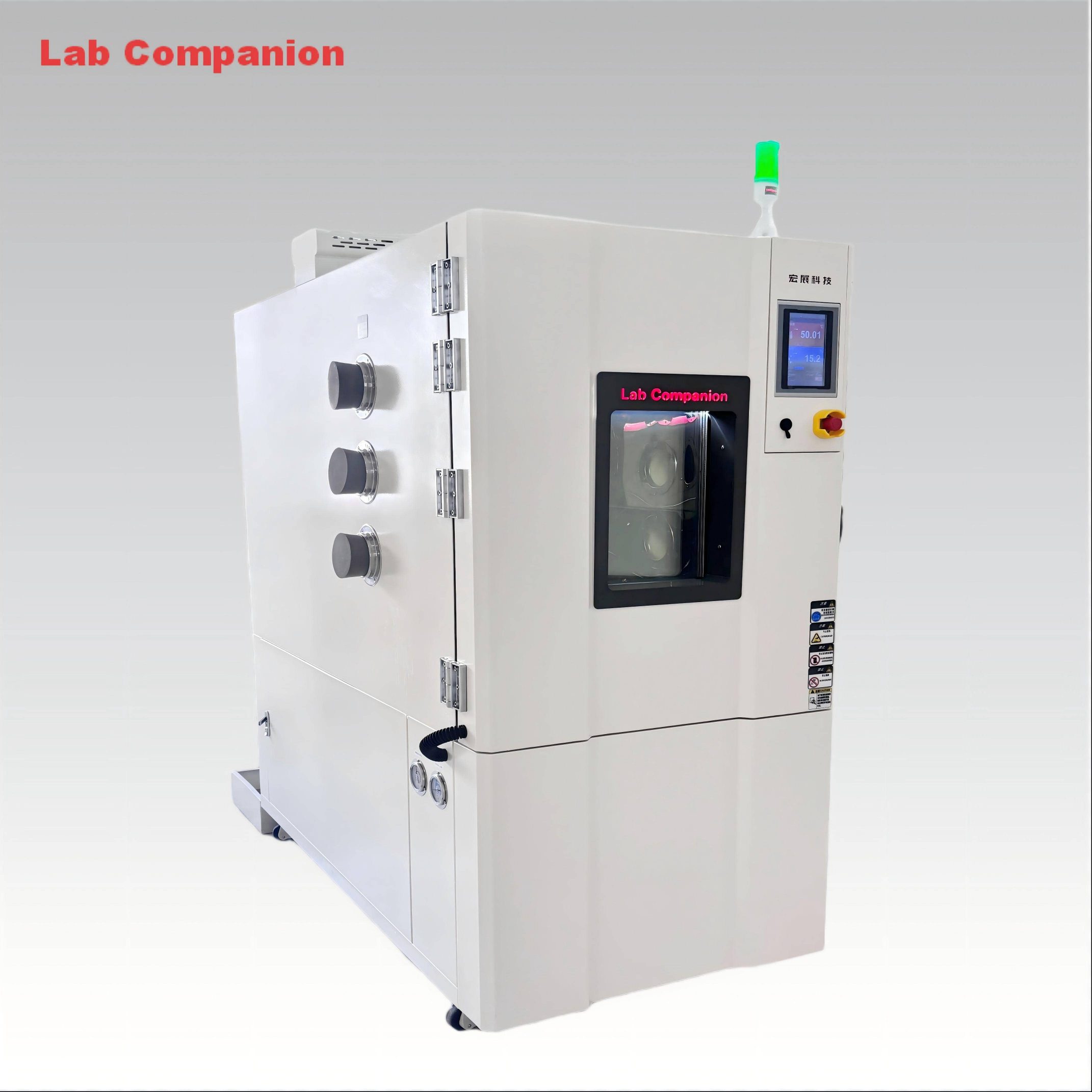
This series supports multiple test types, including rapid temperature change, condensation testing, high-temperature & high-humidity cycling, and combined temperature-humidity tests to meet full ESS requirements for electronic devices. Equipped with the Q8 color touchscreen controller, it features precise temperature control, minimal overshoot and user-friendly operation. The advanced cascade refrigeration system with eco-friendly refrigerants guarantees long-term continuous operation. With a temperature range of -55℃ to +85℃, adjustable temperature change rates of 5℃/min to 15℃/min and temperature uniformity ≤2℃, it fully executes electronic product ESS procedures specified in GJB 1032-90.
5. CNAS Calibration & Compliant Data for Military Assessment
Test data serves as core evidence for military equipment appraisal, type approval and mass production qualification, requiring high authority and traceability. Every Lab Companion chamber is calibrated in a CNAS-accredited laboratory before delivery, with official calibration certificates provided as standard. All test data is directly acceptable for military certification and review, eliminating additional third-party inspection costs. Built-in high-precision data acquisition modules automatically generate timestamped test reports that fully comply with ISO 17025 laboratory data traceability regulations.
6. Practical Industry Cases: Reliable Support for Aerospace Research
Our military and aerospace capabilities have been fully verified in real-world projects. We once customized a 20m³ large-volume test chamber for a key aerospace research institute with full military certification, solving industry pain points such as limited customization options and delayed after-sales service, setting a benchmark for domestic substitution. Our long-term partners include China Aerospace Science and Industry Corporation, China National Institute of Metrology and other leading national defense research institutions, providing stable high-performance environmental test equipment for the national defense and aerospace industry.
Conclusion
To screen high-reliability products, the test equipment itself must pass rigorous screening. Supported by decades of technical accumulation and military-grade quality management, Lab Companion insists on strict quality verification for high-reliability rapid temperature change test chambers. Covering ESS stress screening chambers, rapid temperature cycling chambers and high-low temperature test equipment, we uphold the brand commitment of Authoritative Guarantee for Compliant Testing, delivering traceable, accurate and reliable environmental reliability verification solutions for national defense and military equipment development.
In the field of environmental reliability testing, whether test equipment complies with international IEC standards and national GB mandatory and recommended standards is not only a direct reflection of core equipment performance, but also the core prerequisite for ensuring test data credibility and global mutual recognition of test results. With years of deep expertise in the R&D and manufacturing of environmental test equipment, Lab Companion adheres to the R&D philosophy of "standards first" at all times. Our rapid temperature change test chamber series is strictly aligned with core global and domestic environmental test standards such as IEC 60068-2-14 and GB/T 2423.22 throughout the entire process, from performance parameter calibration and overall structure design to safety specification implementation and factory precision verification. Featuring full-spectrum compliant design, we provide compliant, precise and reliable temperature cycle test solutions for high-precision industries including electronics and electrical appliances, new energy, automotive components, and medical devices.
1. Anchor Authoritative Standards to Lay a Solid Foundation for Test Compliance
Lab Companion rapid temperature change test chambers are developed and designed based on globally recognized environmental test standards, covering all mainstream authoritative industry specifications, perfectly adapting to multi-scenario product testing and certification needs, and fully breaking through barriers for domestic and international certification testing:
• International Standards: Strictly conform to IEC 60068-2-14, Environmental Testing – Part 2: Test Methods – Test N: Temperature Change, fully meeting the core clause requirements for temperature change rate, temperature field uniformity inside the chamber, and test cycle logic. This ensures that test results issued by the equipment are universally recognized and mutually accepted in the international market, helping customers’ products smoothly enter the global market.
• National Standards: Fully comply with GB/T 2423.22-2021, Environmental Testing – Part 2: Test Methods – Test N: Temperature Change, and also align with GB/T 10592-2023, Technical Specifications for High and Low Temperature Test Chambers. The entire process, from equipment manufacturing and performance index calibration to test execution, fully meets mandatory domestic industry requirements.
• Industry-Specific Standards: Flexibly adaptable to specialized testing standards for targeted industries, including automotive electronics AEC-Q series, military MIL-STD-810H, and medical IEC 60601. Truly achieving "one equipment for multi-scenario and multi-standard compliant testing", maximizing the reduction of customers’ equipment investment and testing costs.
2. Fully Compliant Performance Parameters to Precisely Meet Standard Test Requirements
The implementation of authoritative standards hinges on the precise compliance of core equipment performance parameters. Through continuous technological iteration and process optimization, Lab Companion ensures that all core indicators of rapid temperature change test chambers fully fall within the scope specified by standards, eliminating test failure caused by parameter deviations:
• Compliant Temperature Change Rate: In line with the standard requirement for stable linear temperature change control, the equipment supports customized linear temperature change rates ranging from 5℃/min to 25℃/min. The heating and cooling process is smooth and stable without drastic temperature fluctuations, perfectly matching the temperature change rate requirements in IEC and GB core standards. It can perform temperature cycle and alternating tests of conventional, high-speed and other different levels.
• Compliant Temperature Range Coverage: Meeting the standard-specified range for conventional and extreme temperature change tests, the standard model of Lab Companion test chambers covers a temperature range of -70℃ to 150℃, and custom special models can be expanded to -80℃ to 200℃. This fully covers the low-temperature, high-temperature and temperature alternating test intervals specified in standards, satisfying the temperature change reliability assessment needs of various industrial products.
• Compliant Temperature Control Accuracy: IEC and GB standards impose strict restrictions on temperature field accuracy. Lab Companion rapid temperature change test chambers feature a temperature fluctuation of ≤±0.3℃ and temperature uniformity of ≤±0.5℃, maintaining stable control accuracy even under high-speed temperature change conditions. This completely eliminates test data distortion and failure caused by temperature field deviations, ensuring test results meet standard judgment and audit requirements.
3. Dual Compliance of Temperature Field and Test Process to Ensure Authentic and Traceable Test Data
Global authoritative environmental test standards set detailed and strict specifications for temperature field distribution inside the chamber and test execution procedures. Lab Companion optimizes air duct structure and intelligent control systems to realize standardized and compliant operation throughout the entire test process:
• Compliant Temperature Field Uniformity: Equipped with an exclusive dual-circulation air duct and full-area three-dimensional air circulation design, the temperature difference at multiple points within the effective test space of the chamber is strictly controlled within the standard allowable range. There are no dead corners in the temperature field or excessive local temperature differences, fully meeting the mandatory requirements for temperature field uniformity in the effective working space of test chambers specified in standards.
• Compliant Test Programs: Built with a self-developed Q8 intelligent control system, which supports pre-setting temperature cycle programs in line with various authoritative standards. It allows precise setting and one-click retrieval of parameters such as cycle times, holding time, and temperature change slope, and automatically executes the complete test process, minimizing process deviations and operational errors caused by manual operation.
• Compliant Data Recording: Strictly following the standard requirements for traceable and storable test data, the system collects and stores temperature test data accurately in real time. It supports one-click USB data export and automatic temperature curve generation, with data formats and recording methods fully compliant with product certification audit specifications, providing complete and effective data support for customers’ domestic and international product certification and market access.
4. Full Compliance of Safety and Electrical Systems to Balance Performance and Operational Specifications
In addition to core test performance compliance, Lab Companion rapid temperature change test chambers also strictly follow national mandatory safety standards in terms of electrical safety and structural safety, providing all-round protection for test safety:
• Compliant Electrical Safety: Strictly conforms to GB 5226.1, the mechanical electrical safety standard, equipped with multiple protection devices including leakage protection, overload protection, grounding protection and phase loss protection. The overall circuit layout is standardized and orderly, eliminating all kinds of electrical safety hazards from the source.
• Compliant Structural Safety: Designs such as door interlock protection, over-temperature automatic power-off, and abnormal alarm shutdown fully comply with safety operation specifications for environmental test equipment. It effectively prevents risks of accidental opening and misoperation during testing, protecting both operator personal safety and overall equipment safety, and meeting the mandatory requirements for safety protection of test equipment specified in standards.
From alignment with core standards and implementation of key parameters to standardized test procedures and safety protection compliance, Lab Companion rapid temperature change test chambers adopt an extremely rigorous full-process compliant design, ensuring every environmental reliability test is supported by authoritative standards. This is not only Lab Companion’s commitment to product quality, but also a solid equipment guarantee for customers to smoothly pass various domestic and international certifications and quickly expand into the global market.
With the same raw materials and similar heating processes, why do your competitors maintain a drying pass rate of over 98% while your batch defect rate remains stubbornly high, with your pass rate dropping below 70%? Why do your dried finished products frequently suffer from cracking, bubbling, deformation, oxidation and discoloration, leading to surging rework and material waste costs?
With 21 years of deep expertise in industrial oven manufacturing and serving more than 5,000 manufacturing enterprises worldwide, Lab Companion clearly states: 90% of drying process problems stem from incorrect oven selection! When choosing between a vacuum oven and a standard oven, the vast majority of engineers only judge by the single factor of "heating capability", completely ignoring core requirements such as material properties, process precision and production environment. This wrong equipment selection ultimately slows down production, lowers product quality and inflates overall operational costs.
This article draws on Lab Companion’s 21 years of industry practical experience and a vast number of customer implementation cases, to deeply dissect the core differences between vacuum ovens and standard ovens, clarify accurate selection logic, and help every process engineer and procurement professional avoid selection pitfalls and choose the right equipment in one step.
In-Depth Answers to Core Questions: Understand the Differences to Avoid Selection Mistakes
1. Vacuum Oven vs. Standard Oven: What Are the Essential Differences? What Are the Core Advantages of a Vacuum Oven?
Although both appear to be heating and drying equipment, standard ovens and vacuum ovens differ vastly in working principles and applicable scenarios — it is far more than just a matter of "having a vacuum function or not".
Standard Oven: Achieves heating, drying and curing through forced hot air circulation and convection, with air conduction as its core principle. It is an atmospheric pressure drying device, featuring simple structure, easy operation and low procurement cost. However, it has two inherent limitations: first, it is fully exposed to air and cannot isolate oxygen, making it impossible to prevent deterioration of heat-sensitive and oxidizable materials; second, hot air only acts on the material surface, failing to penetrate the interior of porous or complex-structured materials, resulting in incomplete drying and excessive residual moisture and solvents. It is only suitable for basic conventional drying scenarios and cannot meet high-precision, high-demand processes.
Lab Companion Vacuum Oven: Built around the core of hermetic vacuum environment + precise temperature-controlled drying, it completely breaks through the process limitations of standard ovens. Its core advantages and essential differences are concentrated in three key aspects:
1. Efficient Low-Temperature Drying, Protecting Heat-Sensitive Materials: The boiling point of materials is greatly reduced in a vacuum environment, enabling rapid dehydration without high temperatures. This perfectly avoids denaturation, aging and damage to heat-sensitive materials such as semiconductor chips, pharmaceutical raw materials, precision electronic components and lithium battery materials caused by high heat.
2. Air-Isolated Oxygen-Free Drying, Eliminating Oxidation Risks: The fully sealed vacuum environment blocks oxygen and external impurities, fundamentally preventing oxidation, discoloration, rust and corrosion of highly reactive metals, precision components and special polymer materials, significantly improving finished product stability and pass rate.
3. Deep Moisture and Solvent Removal, Eliminating Defective Products: The negative pressure environment can strongly extract residual moisture, gas and organic solvents from micro-pores and gaps inside materials, ensuring thorough drying. It directly solves persistent problems such as product cracking, bubbling, internal delamination and deformation caused by atmospheric drying, making it ideal for the strict drying requirements of high-value, high-precision products.
2. Accurate Selection Guide: When is a Vacuum Oven a Must? When is a Standard Oven Sufficient?
Core Principle for Selection: Do not blindly pursue high-end equipment; choosing the one that fits your process needs is the optimal solution. This approach avoids unnecessary costs while guaranteeing product quality. The scenarios are clearly categorized below for direct reference:
✅ 4 Scenarios Where a Vacuum Oven is Mandatory (Wrong Selection Will Definitely Cause Defects)
• High-value materials as core precision components: Such as semiconductor chips, lithium battery anode and cathode materials, precision electronic assemblies, aerospace parts and pharmaceutical intermediates, where zero oxidation, deformation or impurity contamination is allowed;
• Complex and porous product structures: Such as ceramic components, porous metals, precision molds and composite materials, where atmospheric hot air cannot penetrate the interior and leads to incomplete drying;
• Strict process precision requirements: Residual moisture ≤ 0.1%, or solvent recovery is required, or volatile gas pollution to the workshop must be avoided;
• Special process requirements: Scenarios requiring cross-contamination prevention between materials, oxidation reaction suppression, and oxygen-free drying.
✅ Standard Oven Offers Maximum Cost-Effectiveness for Conventional Scenarios
Lab Companion laboratory ovens and standard industrial ovens are suitable for drying, curing, aging and sterilization of ordinary plastics, hardware, glass and conventional consumables. For scenarios with no special requirements for drying precision, oxygen-free environment or ultra-low residue, they feature lower procurement and operation costs, simpler daily maintenance, and fully meet basic production needs.
3. Why Are Lab Companion Vacuum Ovens the Industry’s Top Choice, Recognized by Leading Enterprises?
Lab Companion vacuum oven series (popular models including DZF-6020/6050) are long-term stable suppliers to top global enterprises, passing strict quality and process verification. They outperform similar products thanks to three core hard-core advantages:
1. Ultra-Precise Temperature Control, Uniform Temperature Field Without Deviation: Equipped with original Japan Fuji temperature controllers and high-precision PT100 thermal resistance sensors, paired with a triple temperature control algorithm (PID + PWM + SSR). The temperature control accuracy reaches ±0.5℃, and temperature field uniformity is ≤3%, far exceeding national standard indicators. This ensures consistent drying effects for every batch of materials, eliminating issues of local over-drying or incomplete drying.
2. Stable Vacuum Performance, Zero Leakage Sealing: Adopts a multi-stage vacuum pump combination design, with an ultimate vacuum degree as low as ≤1Pa and vacuum pressure holding time exceeding 24 hours, delivering exceptional stability; the chamber adopts argon arc welding precision sealing technology with high-quality sealing parts, completely eliminating vacuum leakage risks and maintaining stable performance over long-term use.
3. Intelligent Operation + Dual Safety Protection: Configured with a 7-inch HD touch screen and PLC intelligent control system, supporting custom multi-segment programming settings and automatic operation data export, adapting to automated production needs; built with dual-stage over-temperature power-off protection and explosion-proof safety structure, providing comprehensive safety coverage for laboratory R&D and workshop mass production operations with zero worries.
4. Full Range of Lab Companion Vacuum Oven Models, Customization Available
Lab Companion has developed a full-spec vacuum oven product line for different usage scenarios, covering the entire production process:
• Laboratory Small-Size Models: Classic models such as DZF-6020 and DZF-6050, with a volume of 10L-100L, suitable for laboratory R&D and small-batch trial production;
• Industrial Large-Size Models: Volume ranging from 100L-1000L, with extra-large custom sizes available to meet the needs of industrial large-scale continuous production.
We also provide one-on-one exclusive customization services, tailoring dedicated drying solutions according to customers’ industry (lithium batteries, semiconductors, pharmaceuticals, aerospace, etc.), temperature requirements (room temperature - 500℃), vacuum degree standards, cleanliness levels and special process requirements, perfectly solving drying challenges in various special scenarios.
Selection Summary: Core Differences Lie in Process Compatibility, Right Equipment Reduces Costs and Boosts Efficiency
The core difference between a vacuum oven and a standard oven is not equipment configuration, but process compatibility and scenario adaptability. Standard ovens focus on basic drying with cost-effectiveness as the priority; vacuum ovens focus on high-precision, oxygen-free and deep drying, with quality as the priority.
The key to selection: Stick to your own material properties, process precision requirements and production standards, reject blind selection, to fundamentally solve problems of poor drying, excessive waste and soaring costs.
With 21 years of focus on oven R&D and manufacturing, Lab Companion has become the preferred drying equipment partner for thousands of enterprises worldwide, relying on mature technology, stable products and comprehensive customization services. Choose the right oven, avoid selection pitfalls, directly improve product pass rate, reduce production costs, and make every drying process precise and efficient.
In the reliability testing of electronics, automotive and semiconductor industries, rapid temperature change and high-low temperature shock test chambers are core devices. Both simulate temperature environments but differ significantly in technical logic, test purposes and applicable scenarios. Improper selection may cause distorted test data and delayed R&D cycles. Based on practice, this article analyzes their core differences and provides scientific schemes for accurate model selection.
I. Core Technical Differences: Principles and Parameters
The core difference lies in temperature change mechanisms, leading to variations in parameters and structural design, addressing different test pain points.
(I) Working Principle: Continuous Gradient vs. Instant Switching
Rapid temperature change chambers realize stable temperature rise/fall at a set rate via cascade refrigeration and heating modules, simulating progressive temperature changes. They precisely control temperature slope to avoid overshoot.
High-low temperature shock chambers adopt a two/three-chamber structure, transferring samples between temperature zones in seconds to simulate sudden cold/heat shocks. Their core is to test material tolerance via thermal stress from sudden temperature changes.
(II) Key Parameters: Different Focuses
Rapid temperature change chambers focus on load temperature change rate, control accuracy and uniformity (typical range: -70℃~180℃), suitable for accelerated life testing and compliant with relevant standards.
High-low temperature shock chambers focus on temperature recovery time and extreme range (-80℃~200℃), with fast recovery, suitable for extreme condition simulation and equipped with sample protection.
(III) Structural Design: Single-Chamber vs. Multi-Chamber
Rapid temperature change chambers have a compact single-chamber design for space-limited laboratories and support automatic docking. Shock chambers are larger with independent zones, optimized to reduce crosstalk and customizable with explosion-proof modules.
II. Application Scenario Guide
(I) Rapid Temperature Change Test Chamber
Suitable for slow temperature changes, it is used for functional stability and accelerated life testing in automotive electronics, consumer electronics and communications.
(II) High-Low Temperature Shock Test Chamber
Suitable for instant temperature changes, it tests material and packaging reliability in semiconductors and aerospace, pre-exposing thermal expansion-related defects.
III. Selection Decision and Manufacturer Advantages
Selection core: Match product environment and test purpose — rapid chambers for gradient stability; shock chambers for extreme tolerance; large/high-heat samples prefer rapid chambers.
Domestic brand advantages: High cost-performance (lower price/energy consumption than imports), strong customization and efficient localized after-sales services.
IV. Conclusion
The two devices are complementary. Selection should align with actual working conditions, not just parameters. High-quality domestic brands provide standardized and customized solutions, supporting domestic equipment replacement for reliable testing.
In industrial testing and scientific research, Lab Companion’s environmental test chambers are essential for product reliability verification, widely applied in electronics, automotive, aerospace, home appliances and other sectors. Both chambers focus on temperature range simulation and are easily confused in selection, yet differ sharply in core functions and application scenarios. This guide clarifies their key similarities, differences and scientific selection logic for optimal matching.
I. Key Commonalities
Both are artificial environmental simulation devices for evaluating product stability in extreme temperatures, providing data support for R&D, mass production testing and quality control, and complying with GB, IEC, ISO and other international standards.
1. Overlapping temperature range: -70℃~150℃ for high and low temperature chambers, -40℃~150℃ for constant temperature and humidity chambers, covering most industrial basic temperature test needs.
2. Unified operation & precision: Equipped with intelligent control systems (supporting parameter preset, curve programming, data export); temperature control accuracy ±0.5℃, fluctuation ≤±1℃.
II. Core Differences
The fundamental distinction is the presence of a humidity control module, which defines functional boundaries, application scenarios, structure, cost and O&M:
High and Low Temperature Test Chamber
1. Core Function: Only temperature regulation (heating/cooling/constant temperature), no humidity control module
2. Typical Scenarios: Temperature-only tests, e.g., high/low temperature cycle of electronic components, temperature impact of auto parts
3. Structure: Simplified configuration (heater, refrigeration system); better thermal insulation, smaller footprint for the same specification
4. Cost & O&M: Lower procurement cost; simple routine maintenance for refrigeration/heating system only, low energy consumption
Constant Temperature and Humidity Test Chamber
1. Core Function: Dual regulation of temperature and humidity; humidity range 40%~95%RH (20%~98%RH for premium models), accuracy ±2%RH
2. Typical Scenarios: Temperature-humidity synergy tests, e.g., damp heat aging of electronics, humidity storage of medical devices, damp heat operation of home appliances
3. Structure: Complex configuration (humidification tank, dehumidifier, high-seal box); additional components for professional humidity control
4. Cost & O&M: 15%~30% higher procurement cost by specification; regular O&M for humidity parts (tank cleaning, sensor calibration), relatively higher energy consumption.
III. Selection Guide
Adhere to demand-oriented matching and balance cost performance with the following core principles:
1. Choose High and Low Temperature Test Chamber if: Only temperature change testing is needed, humidity has no impact on results, budget is limited, or laboratory space is narrow (high cost performance, easy O&M)
2. Choose Constant Temperature and Humidity Test Chamber if: Temperature-humidity synergy simulation is required, compliance with industry humidity test standards is needed, or testing moisture/corrosion-prone samples (focus on humidity parameters and reserve O&M budget)
IV. Conclusion
Lab Companion’s two test chambers both deliver stable temperature regulation for diverse industrial needs, with core differences rooted in the humidity control module. The high and low temperature chamber is ideal for basic temperature-only tests with its specialized function and cost efficiency; the constant temperature and humidity chamber excels in complex environmental simulation with its dual temperature-humidity regulation capability.
Abandon the misconception of "more functions = better". Optimal selection relies on integrating core test needs, budget, O&M capacity and laboratory space, to achieve the best balance between test effectiveness and long-term use cost. The two chambers complement each other, forming the core competitiveness of Lab Companion’s environmental test chamber series.
The core advantages of precision ovens developed by Guangdong Lab Companion lie in their ultra-high temperature control accuracy (within ±0.5℃) and excellent temperature field uniformity. These ovens are specifically designed to meet the strict requirements of scenarios that demand precise temperature management, such as drying, curing, aging, and heat treatment processes in various industries. Below are the key industry applications along with detailed practical cases that demonstrate the ovens’ performance and value:
1. Electronics & Electrical Industry
Core Uses: It is widely applied in the electronics manufacturing process, mainly for PCB board drying (effectively removing moisture from solder paste and substrate to ensure welding quality), aging tests of electronic components (such as capacitors, resistors, and diodes, to verify their service life and stability under long-term operation), and chip packaging curing (providing a stable and precise temperature environment to enhance the adhesion and reliability of chip packaging materials).
Case: An electronics manufacturing enterprise specializing in PCB production adopted Lab Companion’s precision oven set at 100℃ for PCB board drying. The oven achieved a temperature control accuracy of ±0.3℃, which effectively prevented cold solder joints and poor contact caused by damp solder paste during the welding process. As a result, the production efficiency was increased by 20%, and the product qualification rate was significantly improved.
2. Automotive Components Industry
Core Uses: It plays an important role in the production and testing of automotive components, including drying of automotive sensors and connectors (removing surface moisture and volatile substances to ensure electrical conductivity and connection stability), aging tests of rubber seals (simulating long-term high-temperature working conditions to test their aging resistance and sealing performance), and curing of automotive paint coatings (accelerating the curing speed of paint and improving its wear resistance and glossiness).
Case: A leading automotive sensor manufacturer used Lab Companion’s precision oven to conduct 24-hour continuous aging tests on its products at 85℃. The stable temperature environment provided by the oven ensured accurate verification of the sensors’ signal transmission stability and working reliability under high-temperature conditions. After the test, the product pass rate reached 99.5%, effectively reducing the failure rate of finished products in actual use.
3. Advanced Materials Industry
Core Uses: It is an essential equipment in the research and production of new materials, mainly used for curing of composite materials (such as carbon fiber and resin composites, to promote the full reaction of resin and enhance the mechanical strength and structural stability of the materials), film drying (removing solvent and moisture from the film surface to ensure its thickness uniformity and surface flatness), and dehydration of powder materials (reducing the moisture content of powder to meet the storage and processing requirements).
Case: A new materials company engaged in carbon fiber product research and development used Lab Companion’s precision oven set at 120℃ for curing carbon fiber sheets. The oven’s temperature field uniformity reached ±1℃, ensuring that each part of the carbon fiber sheet was cured under the same temperature conditions, thus guaranteeing the consistency of material strength and performance. After adopting this equipment, the product reject rate was reduced by 15%, bringing significant economic benefits to the enterprise.
4. Medical & Biotechnology Industry
Core Uses: It is widely used in medical and biological fields with strict hygiene and precision requirements, including drying of medical devices (such as syringes, catheters, and surgical instruments, to remove moisture and meet sterile standards), dehydration of biological reagents (ensuring the stability and effectiveness of reagents by removing excess moisture), and sample pretreatment (drying and processing test samples to improve the accuracy of experimental results).
Case: A clinical laboratory of a top-grade hospital adopted Lab Companion’s precision oven set at 60℃ for drying disposable medical consumables. The mild and stable temperature environment not only met the strict sterile requirements of medical supplies but also avoided damage to the material properties of the consumables caused by excessive temperature, ensuring their safety and reliability in clinical use.
5. Laboratory & Scientific Research Field
Core Uses: It is an indispensable experimental equipment in universities, research institutes, and enterprise R&D centers, mainly used for sample drying (removing moisture from various experimental samples to facilitate subsequent analysis and testing), thermal stability testing of materials (studying the changes of materials under different temperature conditions to master their thermal performance), and small-scale experimental verification (providing a precise temperature environment for pilot tests of new processes and new products).
Case: A materials science laboratory of a key university used Lab Companion’s precision oven with adjustable temperature range of 40-200℃ to carry out research on the thermal aging rules of plastic materials. The oven’s high temperature control accuracy and stable performance ensured that the experimental data had good repeatability, with a repeatability rate of 98%, laying a solid foundation for the laboratory’s scientific research work.
Key Application Guidelines
1. The temperature should be set reasonably according to the properties of the processed materials: for example, the temperature for plastic materials should not exceed 80℃ to avoid deformation or damage, while metal materials can withstand temperatures above 150℃ as needed.
2. A uniform temperature field is crucial to avoid local overheating of materials or incomplete drying, which directly affects the quality and performance of products or experimental results.
Lab Companion’s precision ovens are mainly suitable for industrial production and scientific research scenarios where the requirements for temperature control accuracy are higher than those of conventional ovens, effectively solving the pain points of inaccurate temperature control in traditional heating equipment.
The composite salt spray test chamber is core equipment for corrosion reliability testing of products such as metals and coatings, and its test data directly affects quality evaluation. However, negligence of details during actual operation often leads to distorted results. This article sorts out common mistakes and precautions to improve the standardization of tests.
I. Common Mistakes During Operation
(1) Pre-test Preparation: Basic Omissions Lay Hidden Risks
1. Non-standard salt solution preparation: Estimating salt dosage by experience or failing to use a balance with an accuracy of ≥0.1g easily causes concentration deviation from standards (e.g., 5% sodium chloride solution); using tap water instead of deionized water introduces interfering ions; injecting insufficiently mixed solution tends to clog nozzles and result in uneven salt spray distribution.
2. Improper sample treatment and placement: Unremoved oil and rust on the sample surface prevent salt spray from contacting the substrate; overlapping samples, insufficient spacing, or failure to align with the spray direction at an angle of 15°–30° all lead to data deviation.
3. Perfunctory equipment inspection: Insufficient water in the liquid storage tank may interrupt the test; salt deposits blocking nozzles and air pipes cause inadequate salt spray; uncalibrated temperature and humidity sensors result in loss of control over test conditions.
(2) During the Test: Improper Operation Causes Data Invalidity
1. Arbitrary adjustment of test parameters: Unauthorized modification of parameters such as temperature and salt spray volume leads to inaccurate data; frequent door opening midway disrupts the stable temperature and humidity environment inside the chamber.
2. Neglect of abnormal condition handling: Failure to shut down and troubleshoot anomalies (e.g., uneven salt spray, temperature/humidity fluctuations) results in distorted data. For instance, unaddressed abnormal salt spray deposition (1–2mL/(80cm²·h)) will make corrosion evaluation deviate from actual conditions.
3. Incomplete data recording: Only recording the start and end time without real-time logging of parameters (e.g., temperature and humidity); failing to timely document sample corrosion phenomena impairs subsequent analysis.
(3) Post-test: Improper Follow-up Affects Equipment Service Life and Data Analysis
1. Inadequate equipment cleaning: Residual salt solution corrodes the chamber and pipelines; salt deposits block nozzles and atomizers; corrosion products on the chamber wall contaminate subsequent samples.
2. Rash sample treatment and analysis: Failure to rinse and dry samples in accordance with standards allows residual salt to continue corroding the samples; relying solely on visual observation without instrumental quantitative data leads to unscientific conclusions.
3. Lack of equipment maintenance: Not inspecting sealing rings, lubricating components, or cleaning filters results in frequent equipment failures and shortened service life.
II. Core Precautions: Ensure Test Accuracy and Equipment Stability
1. Standardize solution preparation: Prepare solutions in accordance with standards such as GB/T 10125, weigh salt with a precision balance and use deionized water, verify concentration with a densitometer, and inject the solution after thorough mixing and standing.
2. Standardize sample operation: Degrease, derust, and dry samples; ensure sample spacing ≥20mm, distance from chamber wall ≥50mm, and place samples at 15°–30° to prevent shielding.
3. Comprehensively inspect equipment before testing: Check water level, remove salt deposits, calibrate sensors, and verify airtightness to ensure test conditions meet requirements.
4. Stabilize and control test parameters: Prohibit modification of core parameters; limit door opening time to ≤1 minute; record data hourly; shut down and troubleshoot anomalies before retesting.
5. Maintain and clean equipment post-test: Drain and rinse the equipment thoroughly; process samples in a standardized manner and conduct instrumental analysis; regularly replace filters, inspect sealing rings, and keep detailed maintenance records.
III. Conclusion
The quality of composite salt spray test chamber operation hinges on standardized procedures. Avoiding common mistakes and strictly following precautions ensures data accuracy to support product quality control, while extending equipment service life and reducing costs. Standardization is the core of accurate testing.
In the corrosion resistance testing of metal materials, coatings and components, the composite salt spray test chamber is an indispensable core equipment. It breaks through the limitations of traditional single salt spray tests, can simulate complex natural environments, and provides accurate data for product reliability evaluation. The following analyzes its key performance from four core dimensions.
I. Accurate Environmental Parameter Control Capability
Composite salt spray tests have extremely high precision requirements for parameters such as temperature, humidity and salt spray concentration, and the control performance of the equipment directly determines the validity of test data.
Temperature and Humidity Control: Supports wide-range adjustment of temperature (5℃-50℃) and humidity (45%-98%RH) in the salt spray chamber. The temperature fluctuation is ≤±0.5℃ and the humidity deviation is ≤±3%RH, which can stably simulate typical corrosive environments such as high humidity in coastal areas and high temperature with high salt.
Salt Spray Concentration Regulation: The salt water injection volume is controlled by a high-precision metering pump, and the salt spray sedimentation volume is stably maintained at 1-2ml/(80cm²·h). It supports the preparation of sodium chloride solution with a concentration of 5%-20%, and is also compatible with special test requirements such as acetic acid and copper-accelerated acetic acid salt spray (CASS).
II. Multi-dimensional Environmental Simulation Capability
Different from traditional salt spray machines, the core advantage of composite models lies in the simulation of "composite" scenarios, which can reproduce the synergistic corrosion effect of "salt spray + humidity + temperature cycle" in natural environments.
Multi-mode Switching: Supports seamless switching between three modes: continuous salt spray, intermittent salt spray and damp-heat cycle. For example, it simulates the alternating environment of high-temperature salt spray during the day and low-temperature high-humidity at night, which is closer to the actual service scenario of products.
Full-range Corrosion Coverage: The diameter of salt spray particles is controlled at 1-5μm. Through the annular layout of multiple nozzles, the uniform distribution of salt spray in the chamber is realized, covering the test samples without dead ends, ensuring the comparability of corrosion degrees of samples at different positions.
III. Stable and Reliable Operation Performance
Corrosion resistance tests often last for several days to months, and the long-term operation stability of the equipment is the key to ensuring the smooth completion of the test.
Anti-corrosion Structure Design: The inner tank of the test chamber is made of 316L stainless steel, and the nozzles are made of salt-corrosion-resistant ceramic materials, which can effectively resist the corrosion of the equipment itself by salt spray and extend its service life.
Intelligent Protection Mechanism: Equipped with functions such as low salt water level alarm, over-temperature protection and compressor overload protection. It will automatically shut down and give a prompt when parameters are abnormal, avoiding test interruption or sample damage.
IV. Convenient Operation and Data Management
Humanized operation design and complete data recording functions improve test efficiency and ensure data traceability.
Intelligent Control: Adopts a 7-inch touch screen, supports test parameter presets and automatic process operation, and can store more than 100 sets of test schemes, facilitating the call of repeated tests for similar products.
Data Visualization: Displays real-time data such as temperature, humidity and salt spray sedimentation in the chamber, supports regular data printing and USB export, and meets the standardization requirements of test reports.
Conclusion
The composite salt spray test chamber’s core performance lies in the integration of "precision control, multi-dimensional simulation and stable operation". For corrosion resistance testing of auto parts, marine engineering equipment or electronic components, a reliable chamber provides strong data support for product quality enhancement.
As a "quality gatekeeper" in industrial manufacturing and R&D, environmental test chambers simulate extreme conditions (high/low temperature, damp heat, salt spray, etc.) to pre-expose product defects and verify reliability, acting as the hidden "ultimate examiner" in labs.
Core Value: Preempting Potential Failures
Products face diverse harsh environments in real use: Antarctic mobile phones endure -40℃ cold, coastal auto parts resist salt spray corrosion, and aerospace components withstand drastic temperature-humidity fluctuations. Post-market exposure of environmental adaptability issues triggers safety risks, massive economic losses, and brand damage.
The chamber’s core role is to artificially replicate extreme environments or accelerated stresses in labs, condensing years of natural environmental testing into days/hours. It proactively identifies material aging, structural deformation, and performance degradation, providing data for R&D optimization and quality control.
Mainstream Types: Targeted Testing for Scenarios
Environmental test chambers are not one-size-fits-all; different types match specific testing needs:
High/Low Temperature Test Chamber: The basic type, simulating -70℃ to 150℃ (extended ranges for special models) to test product stability under temperature shocks, e.g., chip startup performance and plastic part thermal deformation.
Temperature Humidity Test Chamber: Adds 30%RH-98%RH humidity control to high/low temperature functions, simulating plum rain or tropical environments to assess moisture/mildew resistance, such as appliance casing rust-proofing and textile color fastness.
Salt Spray Test Chamber: Sprays neutral/acidic salt spray to simulate marine/industrial corrosion, testing metal and coating corrosion resistance for automotive, marine, and hardware industries.
Comprehensive Environmental Test Chamber: Integrates temperature, humidity, vibration, and light to replicate complex scenarios (e.g., aerospace launch/operation environments), serving as core equipment for high-end R&D.
Procurement & Usage: Key to Avoiding Risks
Demand Matching: Avoid over-pursuing ultra-wide ranges; define temperature/humidity limits and accuracy based on standards (IEC, GB, MIL-STD). For example, consumer electronics do not require military-grade wide-temperature equipment to prevent resource waste.
Core Performance Focus: Prioritize temperature uniformity, temp-humidity fluctuation (control accuracy), and temperature rise/fall rate (test efficiency), as these directly affect data reliability. Safety features (over-temperature alarm, water shortage protection) are also non-negligible.
Industry Trends: Intelligent & Green Upgrades
Driven by Industry 4.0, chambers are evolving toward intelligence: IoT modules enable remote monitoring and data traceability, while AI optimizes test parameters to cut manual intervention. Greenization is another direction—advanced refrigeration systems and insulation materials reduce energy consumption, aligning with green manufacturing concepts.
From consumer electronics and aerospace to automotive and medical devices, environmental test chambers underpin product reliability, laying a foundation for enterprise R&D and innovation. In the "quality-first" era, their value as the "ultimate examiner" will grow increasingly prominent.
Test chambers, as core equipment for environmental reliability testing across industries such as electronics, automotive, aerospace, and new energy, rely on a multi-dimensional, redundant safety protection system to ensure long-term operational stability, personnel safety, and the integrity of test samples and equipment. Beyond basic safety guarantees, these protection mechanisms are designed to adapt to complex test scenarios and extreme environmental conditions. Here’s a professional and detailed breakdown of the core protection settings:
1. Refrigeration System Protection
Compressor protection: Equipped with overpressure, overheating, and overcurrent triple protection mechanisms. Real-time monitoring of operating pressure, exhaust temperature, and working current prevents compressor burnout, cylinder scuffing, or seal damage caused by abnormal conditions such as refrigerant leakage, pipeline blockage, or voltage fluctuations.
Refrigerant protection: Integrated high/low pressure switches and overload protection devices continuously monitor the refrigerant circulation system. When pressure exceeds the safe threshold or the system is overloaded, the device automatically cuts off the corresponding circuit and triggers an alarm, ensuring stable refrigerant flow and avoiding system damage due to pressure anomalies.
2. Test Area Protection
Multi-layer over-temperature protection (redundant design):
1st layer: Adjustable high/low temperature over-temperature protection, dynamically linked to the set operating control temperature. When the test area temperature deviates from the set range by a preset value, the system automatically adjusts the heating/cooling module or pauses operation to prevent sample damage.
2nd/3rd layers: Independent electronic high-temperature over-temperature protection devices (double redundancy). Directly connected to the power supply circuit, these devices bypass the main control system to cut off power immediately if the 1st layer protection fails, eliminating potential fire hazards or equipment damage caused by excessive temperature.
Fan motor overcurrent protection: Monitors the operating current of the test area circulation fan. If the motor jams, wears, or experiences current surges due to other faults, the protection system triggers an alarm and cuts off power to avoid motor burnout and ensure uniform temperature distribution in the test chamber.
Fault alarm system: Integrates sound and light alarms with a digital display. When abnormalities occur (e.g., over-temperature, water shortage, or sensor failure), the system immediately cuts off the relevant power supply, activates the alarm, and displays the specific fault cause on the control panel for quick troubleshooting.
Active water shortage reminder: For humidity-controlled test chambers, a real-time water level monitoring sensor in the humidity water tank triggers an audible and visual alarm when the water level is too low. The system pauses the humidity control function to prevent dry burning of the humidifier and ensure the stability of the humidity control system.
Dynamic high/low temperature protection: Real-time adapts to the set test parameters (temperature range, rate of change). During rapid temperature rise/fall or extreme temperature tests, the protection system dynamically adjusts the safety threshold to avoid false triggers while ensuring comprehensive protection against temperature anomalies.
3. General Electrical Protection
Main power supply protection: Equipped with phase sequence and phase loss protection devices. Automatically detects the phase sequence and integrity of the three-phase power supply; if phase sequence reversal or phase loss occurs, the system locks the power supply and alarms to prevent damage to the compressor, fan, and other core components caused by incorrect power supply.
Short circuit & leakage/surge protection: Configured with high-sensitivity short circuit breakers to quickly cut off power in case of line short circuits, avoiding electrical fires or component burnout. Equipped with leakage circuit breakers and RC electronic surge protectors to prevent electric shock hazards caused by equipment leakage and suppress voltage surges from the power grid, protecting the control system and electronic components.
Sensor self-detection: Real-time self-inspection of temperature, humidity, and other key sensors. If a sensor malfunctions (e.g., signal loss, inaccurate measurement), the system immediately alarms and switches to backup sensor data (if equipped) or pauses operation to ensure the reliability of test data and prevent misoperation due to false sensor signals.
Dry heating protection (humidity water circuit): For the humidity water circuit and humidifier, a dedicated dry heating protection device monitors the water level and heating status. If the humidifier heats without water, the protection system cuts off the heating power immediately to avoid humidifier burnout and extend the service life of the humidity system.
Expandable protection: Reserved 2 fault detection input interfaces, supporting customized addition of special protection modules (e.g., gas leakage protection for flammable/explosive test samples, pressure protection for sealed test chambers) to meet the safety requirements of industry-specific test scenarios.
These multi-layered, redundant, and configurable protection mechanisms form a comprehensive safety barrier for test chambers. Whether in routine reliability testing or extreme environmental simulations, they ensure the equipment operates stably and reliably, while maximally safeguarding the safety of operators, test samples, and the equipment itself—becoming a key guarantee for the accuracy of test results and long-term operational efficiency.
As core equipment for industrial testing, the customization level of walk-in environmental test chambers directly determines testing accuracy and efficiency. This article breaks down the entire process from requirement communication to final delivery, helping enterprises clearly grasp the key nodes of customization.
1. Accurate Requirement Communication: Clarify Core Parameters
The first step in customization is to define core technical parameters, which lay the foundation for subsequent design.
Size Range: Covering small test spaces of 4m³ to large walk-in test chambers of 260m³, the size should be determined based on the volume, quantity of test samples and operational space requirements.
Temperature & Humidity Range: It can generally achieve temperature control of -70℃~+180℃ and humidity control of 30%R.H~98%R.H. For special scenarios, the range can be further expanded to -73℃~+177℃ (integral type).
Control Method: Multiple options are available, from basic microchip LED displays to PLC programmable logic controller touch screens, and can also be upgraded to remote centralized control systems to meet different operation and management needs.
Structure Type: Selection should be based on application scenarios, with parameters of three mainstream types as follows:
Test Type
Temperature Range
Humidity Range
Temperature Change Rate
Integral Type
-73℃~+177℃
30%~95%RH
4~5℃/min, or faster
Assembled Type
-68℃~+85℃
30%~95%RH
1~2℃/min
Steady-state Type
-20℃~+50℃
30%~95%RH
N/A
2. Scheme Design & Confirmation: Balance Professionalism and Practicality
After clarifying requirements, the technical team will issue a customization scheme, which mainly includes three parts:
Structural Design: Based on size and type, plan the layout of the test chamber's door, observation window and sample rack to ensure operational convenience and airtightness.
System Matching: Equip with corresponding refrigeration, heating, humidification and dehumidification systems to ensure temperature and humidity control accuracy, and configure hardware and software according to the control method.
Compliance Verification: The scheme must conform to relevant industry standards (such as GB/T, IEC, etc.), and confirm with the customer whether it needs to meet specific industry testing specifications.
After scheme confirmation, detailed drawings and technical agreements will be generated to clarify the rights, obligations and delivery standards of both parties.
3. Production & Manufacturing: Strictly Control Process and Quality
Entering the production stage, the process will be controlled around the two cores of "accuracy" and "stability":
Core Component Procurement: Select high-reliability compressors, sensors, controllers and other core components to ensure long-term operational stability of the equipment.
Modular Production: Assembled equipment adopts modular manufacturing to reduce on-site installation errors; integral equipment undergoes integrated assembly and preliminary debugging.
Factory Inspection: Each piece of equipment must undergo no-load temperature and humidity calibration and operational stability testing. Only after confirming that the parameters meet the design requirements can shipment be arranged.
4. Installation, Commissioning & Delivery: Ensure On-site Application
After the equipment arrives at the site, the professional team will provide full-process services:
On-site Installation: Carry out equipment positioning, pipeline connection and circuit debugging according to site conditions; for assembled equipment, ensure airtight connection of each module.
Accuracy Calibration: Combine the customer's testing needs, use professional instruments to perform on-site calibration of temperature and humidity uniformity and fluctuation to ensure compliance with test requirements.
Training & Delivery: Provide equipment operation and maintenance training for the operation team, and deliver technical materials such as operation manuals and calibration reports to complete the final acceptance.
Would you like me to supplement an English Version of Walk-in Environmental Test Chamber Customization Requirement Confirmation Form? It will list key parameter check items and common questions to facilitate quick alignment of requirements between you and your customers.
As a core device for environmental reliability testing, the rapid temperature change test chamber is widely used in electronics, automotive, and other industries due to its ability to achieve drastic temperature variations. Its high/low temperature performance and rapid temperature change capability directly affect test data accuracy, operational safety, and equipment service life. Below are the core operational precautions:
I. Pre-Startup: Conduct Basic Inspections
Comprehensive pre-startup checks are critical for preventing malfunctions, focusing on "medium, status, and connections":
Medium & Pipeline Inspection: Verify that the cooling system's liquid level and pressure meet standards, with no pipeline leakage or blockage. Check the refrigerant system pressure to avoid cooling failure or compressor damage due to insufficient medium.
Equipment Status Confirmation: Ensure the chamber door seal is intact (poor sealing reduces temperature change rate and increases energy consumption). Keep the chamber interior clean and free of debris, and ensure sensor surfaces are free of oil and dust to avoid temperature measurement interference.
Electrical Connection Check: Confirm power and control cables are securely connected, and the grounding resistance complies with specifications (≤4Ω) to prevent electric leakage or electromagnetic interference.
II. Sample Placement: Prioritize Scientific Standards
Proper sample placement ensures test authenticity, adhering to the principles of "no interference, no overrun, easy monitoring":
Weight & Volume Control: Total sample weight must not exceed the rated load. Single sample volume ≤ 1/3 of the working chamber. Maintain a distance of ≥5cm from the chamber walls and sensors to avoid uneven local temperature caused by airflow blockage.
Sample Compatibility: Never place flammable, explosive, corrosive, or toxic samples. For heat-generating samples, specify power in advance to ensure compatibility with the equipment's heat dissipation capacity and prevent overload.
Fixing & Wiring Specifications: Secure samples with dedicated brackets to prevent displacement during temperature changes. Use high-temperature resistant insulated wires for energized tests to avoid short circuits and aging.
III. Operation Process: Precise Monitoring & Adjustment
Dynamic monitoring during operation guarantees test reliability, focusing on "parameters, status, and abnormalities":
Parameter Setting & Verification: Set temperature range, change rate, and other parameters per standards and re-verify. Adjust only after the equipment stabilizes to avoid system fluctuations.
Operation Status Monitoring: Real-time monitor temperature curves and indicator lights to ensure the deviation between actual and set temperatures ≤ ±1℃. Listen for abnormal noises from components like the compressor and shut down immediately if detected.
Abnormal Handling: If the equipment triggers over-temperature, overload, or other protections, do not force reset. First troubleshoot the cause (e.g., abnormal sample heating, unstable voltage) before restarting.
IV. Post-Test: Standardized Shutdown & Maintenance
Proper post-test procedures extend equipment life, following three steps: "cooling, cleaning, and recording":
Gradual Cooling to Prevent Damage: After testing, open the door only when the chamber temperature drops to room temperature (20-25℃) and the temperature difference with the outside ≤10℃, avoiding sample condensation or chamber wall damage.
Cleaning & Maintenance: Wipe the chamber interior and door seal with a dry cloth. Use dedicated cleaners for leaked substances. Remove dust from the equipment exterior to ensure unobstructed heat dissipation.
Data & Status Recording: Document test parameters, curves, and abnormalities. After turning off the power, cut off the cooling medium supply and organize wires and brackets.
V. Long-Term Maintenance: Extend Equipment Lifespan
Regular maintenance prolongs service life:
Monthly: Check the door seal elasticity and replace if aged.
Quarterly: Clean the condenser and evaporator.
Annually: Arrange professional inspection and maintenance of the compressor and refrigeration system.
The core of test chamber operation is "safety first, standardized operation, and precise monitoring." Strict adherence to the above precautions ensures safety, reliable test data, and extended equipment life, providing strong support for product reliability verification.




 एक कहावत कहना


 IPv6 नेटवर्क समर्थित