बैनर
घर

तापमान परीक्षण उपकरण

तापमान परीक्षण उपकरण

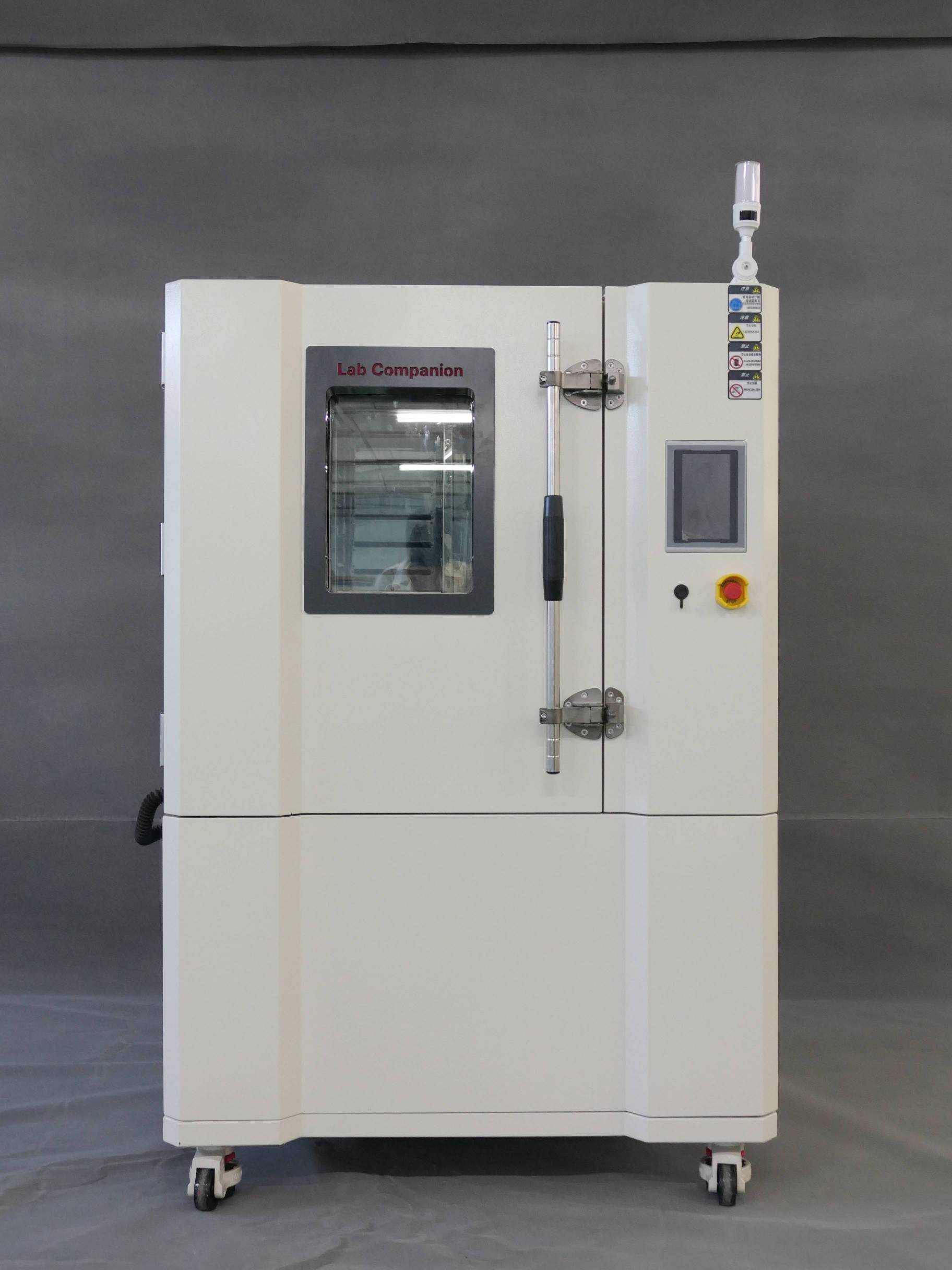
  • Small Rapid Temperature Change (Wet Heat) Test Chamber
    Nov 01, 2025
    In response to the testing and R&D requirements of electronic components such as semiconductors and automotive electronics, Lab Companion has developed a smaller capacity small rapid temperature change (wet heat) test chamber. While maintaining the advantages of standard rapid temperature change test chambers, it can also meet the needs of customers who have requirements for space size, with a single-phase 220VAC voltage specification. It can also meet the equipment usage requirements of customers in civilian office areas such as research institutions and universities. Its main features are as follows: 1. It has powerful heating and cooling performance 2. Heating rate: 15℃/min; Cooling rate: 15℃/min 3. (Temperature range: -45℃ to +155℃) 4. Single-phase 220VAC, meeting the electricity demands of more customers 5. Single-phase 220VAC, suitable for industrial and civil power supply specifications, can meet the equipment power demands of customers in civil office areas such as research institutions and universities. 6. The body is small and exquisite, with a compact structure and easy to move 7. The miniaturized structure design of the test chamber can effectively save configuration space. 8. The inner tank volume is 100L, the width is 600mm, the depth is less than 1400mm, and the product volume is less than 1.1m ³. It is suitable for the vast majority of residential and commercial elevators in China (GB/T7025.1). 9. The standard universal wheels enable the product to move freely at the installation site. 10. Standard air-cooled specification is provided, facilitating the movement and installation of the product 11. At the same time, it saves customers the cost and space of configuring cooling towers. 12. A more ergonomic operation touch screen design 13. Through the multi-angle adjustment of the touch screen, it can meet the operation needs and provide the best field of vision for users of different heights, making it more convenient and comfortable. 14. Energy-saving cold output temperature and humidity control system, with dual PID and water vapor partial pressure control, features mature technology and extremely high precision. 15. Network control and data acquisition can be carried out through the interface (RS-485/GPIB/Web Lan/RS-232C). 16. It is standard-equipped with left and right cable holes (50mm), which facilitates the connection of power on the sample and the conduct of multiple measurements. 17. The controller adopts a color LCD touch screen, which is simple and convenient to operate 18. Through the controller, two control methods, fixed value and program, can be selected to adapt to different applications. 19. The program control can be set to 100 modes, with 99 steps for each mode. Repeat the loop up to 999 times. 20. Multiple languages can be easily switched (Simplified Chinese, English), and test data can be stored on a USB flash drive.
    और पढ़ें
  • Flame-retardant PP Materials in Industry Working Principle
    Oct 27, 2025
    Polypropylene (PP) itself is a highly flammable hydrocarbon with a limiting oxygen index (LOI) of only 17.8%. It will continue to burn even after being removed from the fire source. The core principle of flame-retardant PP is to interrupt or delay its combustion cycle through physical and chemical means. Combustion requires the simultaneous existence of three elements: combustible material, heat and oxygen. The function of flame retardants is to destroy this "burning triangle".   In industry, flame retardancy is mainly achieved by adding flame retardants to PP. Different types of flame retardants function through the following mechanisms: 1. Gas-phase flame retardant mechanism This is one of the most common mechanisms, especially applicable to traditional halogen-based flame retardants. When flame retardants are heated and decomposed, they can capture the free radicals (such as H· and HO·) that maintain the combustion chain reaction in the combustion reaction zone (flame), causing their concentrations to drop sharply and thus interrupting the combustion. 2. Condensed phase flame retardant mechanism This is the most mainstream mechanism of halogen-free flame-retardant PP. Flame retardants promote the formation of a uniform and dense carbon layer on the surface of polymers. This layer of carbon has three major functions. The first step is to prevent external heat from entering the interior of the polymer. Secondly, it prevents the escape of flammable gases inside and the entry of external oxygen. Finally, it inhibits the further pyrolysis of the polymer and the generation of smoke. When a fire occurs, the acid source promotes the dehydration, cross-linking and carbonization of the carbon source. Meanwhile, the large amount of gas produced by the decomposition of the gas source causes the softened carbon layer to expand, eventually forming a porous, dense and strong foam carbon layer, which protects the underlying PP like "armor". 3. Cooling/heat absorption mechanism Flame retardants absorb a large amount of heat during the decomposition process, reducing the surface temperature of polymers and making it difficult for them to continuously pyrolyze and produce flammable gases. Typical representatives include aluminium hydroxide (ATH) and magnesium hydroxide (MH). When they decompose, they absorb a large amount of heat (endothermic reaction) and release water vapor. The water vapor can not only dilute flammable gases but also play a cooling role. 4. Dilution mechanism Flame retardants decompose to produce a large amount of non-flammable gases (such as water vapor and CO₂, etc.), which can dilute the concentration of flammable gases and oxygen near the polymer surface, making combustion unsustainable. Both the gas sources of metal hydroxides and intumescent flame retardants have this function.   In conclusion, the working principle of flame-retardant PP in industry is a complex process involving the synergy of multiple mechanisms. Modern flame-retardant PP technology is developing towards halogen-free, low smoke, low toxicity and high efficiency. Among them, the condensed phase flame-retardant mechanism represented by intumescent flame retardants (IFR) is the core of current research and application. By carefully designing flame-retardant formulas, the best balance can be achieved among flame-retardant efficiency, material mechanical properties, processing performance and cost.
    और पढ़ें

  • How is over-temperature protection carried out in a temperature test chamber?
    Oct 23, 2025
    The over-temperature protection of the temperature test chamber is a multi-level and multi-redundant safety system. Its core purpose is to prevent the temperature inside the chamber from rising out of control due to equipment failure, thereby protecting the safety of the test samples, the test chamber itself and the laboratory environment.   The protection system usually consists of the following key parts working together: 1. Sensor: The main sensor is used for the normal temperature control of the test chamber and provides feedback signals to the main controller. An independent over-temperature protection sensor is the key to a safety system. It is a temperature-sensing element independent of the main control temperature system (usually a platinum resistance or thermocouple), which is placed by strategically at the position within the box that best represents the risk of overheating (such as near the heater outlet or on the top of the working chamber). Its sole task is to monitor over-temperature. 2. Processing unit: The main controller receives signals from the main sensor and executes the set temperature program. The independent over-temperature protector, as an independent hardware device, is specifically designed to receive and process the signals from the over-temperature protection sensor. It does not rely on the main controller. Even if the main controller crashes or experiences a serious malfunction, it can still operate normally. 3. Actuator: The main controller controls the on and off of the heater and the cooler. The safety relay/solid-state relay receives the signal sent by the over-temperature protector and directly cuts off the power supply circuit of the heater. This is the final execution action.   The over-temperature protection of the temperature test chamber is a multi-level, hard-wire connected safety system designed based on the concepts of "redundancy" and "independence". It does not rely on the main control system. Through independent sensors and controllers, when a dangerous temperature is detected, it directly and forcibly cuts off the heating energy and notifies the user through sound and light alarms, thus forming a complete and reliable safety closed loop.
    और पढ़ें
  • वायु वाल्व द्वारा परीक्षण कक्ष के अंदर तापमान को संतुलित करने का सिद्धांत
    Sep 22, 2025
    इसका मूल सिद्धांत "हीटिंग - मापन - नियंत्रण" की एक बंद-लूप नकारात्मक प्रतिक्रिया प्रणाली है। सरल शब्दों में, इसका उद्देश्य बाहरी वातावरण से होने वाले ताप अपव्यय को रोकने के लिए बॉक्स के अंदर हीटिंग तत्वों की शक्ति को सटीक रूप से नियंत्रित करना है, जिससे परिवेश के तापमान से अधिक एक स्थिर परीक्षण तापमान बनाए रखा जा सके। वायु वाल्व द्वारा तापमान को स्थिर करने की प्रक्रिया एक गतिशील और निरंतर समायोजनशील बंद लूप है: सबसे पहले, एक लक्षित तापमान निर्धारित करें। तापमान सेंसर बॉक्स के अंदर वास्तविक तापमान को वास्तविक समय में मापता है और सिग्नल को PID नियंत्रक तक भेजता है।जब PID नियंत्रक त्रुटि मान की गणना करता है, तो वह उस तापन शक्ति की गणना करता है जिसे PID एल्गोरिथम के माध्यम से त्रुटि मान के आधार पर समायोजित करने की आवश्यकता होती है। एल्गोरिथम तीन कारकों को ध्यान में रखेगाP (अनुपात): धारा त्रुटि कितनी बड़ी है? त्रुटि जितनी ज़्यादा होगी, तापन शक्ति की समायोजन सीमा उतनी ही ज़्यादा होगी।I (अभिन्न) : एक निश्चित समयावधि में त्रुटियों का संचय। इसका उपयोग स्थैतिक त्रुटियों को दूर करने के लिए किया जाता है (उदाहरण के लिए, यदि हमेशा थोड़ा सा विचलन होता है, तो समाकलन पद धीरे-धीरे अपनी शक्ति बढ़ाकर उसे पूरी तरह से समाप्त कर देगा)।D (अंतर) : धारा त्रुटि में परिवर्तन की दर। यदि तापमान तेज़ी से लक्ष्य के निकट पहुँच रहा है, तो यह "ओवरशूट" को रोकने के लिए पहले से ही तापन शक्ति को कम कर देगा।3. पीआईडी ​​नियंत्रक हीटिंग तत्व (जैसे कि एक ठोस-अवस्था रिले एसएसआर) के पावर नियंत्रक को गणना संकेत भेजता है, जो हीटिंग तार पर लागू वोल्टेज या धारा को सटीक रूप से नियंत्रित करता है, जिससे इसकी गर्मी उत्पादन को नियंत्रित किया जाता है।4. परिसंचारी पंखा लगातार काम करता रहता है ताकि यह सुनिश्चित हो सके कि गर्म करने से उत्पन्न ऊष्मा तेज़ी से और समान रूप से वितरित हो। साथ ही, यह तापमान संवेदक के सिग्नल परिवर्तनों को नियंत्रक तक तेज़ी से वापस भेजता है, जिससे सिस्टम की प्रतिक्रिया अधिक समय पर हो जाती है। वायु वाल्व संतुलन यंत्र वायु का आयतन मापता है, जबकि वायु का घनत्व तापमान के साथ बदलता रहता है। समान विभेदक दाब मान पर, विभिन्न घनत्वों वाली वायु के लिए द्रव्यमान प्रवाह दर या आयतन प्रवाह दर भिन्न होती है। इसलिए, तापमान को एक ज्ञात निश्चित मान पर स्थिर किया जाना चाहिए ताकि उपकरण के अंदर का माइक्रोप्रोसेसर पूर्व निर्धारित सूत्र का उपयोग करके मापे गए विभेदक दाब मान के आधार पर मानक परिस्थितियों में वायु आयतन मान की सटीक गणना कर सके। यदि तापमान अस्थिर है, तो माप परिणाम अविश्वसनीय होंगे।
    और पढ़ें
  • लैब कम्पैनियन एयर-कूल्ड मैकेनिकल कम्प्रेशन रेफ्रिजरेशन का कार्य सिद्धांत लैब कम्पैनियन एयर-कूल्ड मैकेनिकल कम्प्रेशन रेफ्रिजरेशन का कार्य सिद्धांत
    Sep 06, 2025
    1.संपीड़ननिम्न-तापमान और निम्न-दाब वाला गैसीय रेफ्रिजरेंट वाष्पक से बाहर निकलता है और संपीड़क द्वारा अंदर खींच लिया जाता है। संपीड़क गैस के इस भाग पर कार्य करता है (विद्युत ऊर्जा की खपत करता है) और इसे तीव्रता से संपीड़ित करता है। जब रेफ्रिजरेंट उच्च-तापमान और उच्च-दाब वाले अति-तापित वाष्प में बदल जाता है, तो वाष्प का तापमान परिवेश के तापमान से बहुत अधिक होता है, जिससे ऊष्मा के बाहर निकलने की स्थिति उत्पन्न होती है।2. संघननउच्च-तापमान और उच्च-दाब वाला रेफ्रिजरेंट वाष्प कंडेन्सर (आमतौर पर तांबे की नलियों और एल्युमीनियम के पंखों से बना एक पंखदार ट्यूब हीट एक्सचेंजर) में प्रवेश करता है। पंखा परिवेशी वायु को कंडेन्सर के पंखों के ऊपर से बहने के लिए मजबूर करता है। इसके बाद, रेफ्रिजरेंट वाष्प कंडेन्सर में प्रवाहित वायु में ऊष्मा छोड़ता है। ठंडा होने के कारण, यह धीरे-धीरे गैसीय अवस्था से मध्यम-तापमान और उच्च-दाब वाले द्रव में संघनित हो जाता है। इस बिंदु पर, ऊष्मा रेफ्रिजरेशन सिस्टम से बाहरी वातावरण में स्थानांतरित हो जाती है।3. विस्तारमध्यम तापमान और उच्च दाब वाला तरल रेफ्रिजरेंट एक संकरी नली से थ्रॉटलिंग उपकरण के माध्यम से प्रवाहित होता है, जो दबाव को कम करने और कम करने का काम करता है, ठीक वैसे ही जैसे पानी के पाइप के खुले हिस्से को उंगली से बंद कर दिया जाता है। जब रेफ्रिजरेंट का दाब अचानक गिरता है, तो तापमान भी तेज़ी से गिरता है, और एक निम्न तापमान और निम्न दाब वाले गैस-तरल द्वि-चरणीय मिश्रण (धुंध) में बदल जाता है।4. वाष्पीकरणनिम्न-तापमान और निम्न-दाब वाला गैस-द्रव मिश्रण बाष्पित्र में प्रवेश करता है, और एक अन्य पंखा बाष्पित्र के ठंडे पंखों के माध्यम से बॉक्स के अंदर हवा का संचार करता है। शीतलक द्रव बाष्पित्र में पंखों से होकर बहने वाली हवा की ऊष्मा को अवशोषित करता है, तेज़ी से वाष्पित होकर वाष्पीकृत हो जाता है, और पुनः निम्न-तापमान और निम्न-दाब वाली गैस में परिवर्तित हो जाता है। ऊष्मा के अवशोषण के कारण, बाष्पित्र से होकर बहने वाली हवा का तापमान काफी कम हो जाता है, जिससे परीक्षण कक्ष ठंडा हो जाता है। इसके बाद, यह कम तापमान और कम दबाव वाली गैस फिर से कंप्रेसर में खींची जाती है, जिससे अगला चक्र शुरू होता है। इस तरह, यह चक्र अंतहीन रूप से दोहराया जाता है। रेफ्रिजरेशन सिस्टम लगातार बॉक्स के अंदर की गर्मी को बाहर की ओर "स्थानांतरित" करता है और पंखे के माध्यम से उसे वायुमंडल में छोड़ देता है।
    और पढ़ें

एक संदेश छोड़ें

एक संदेश छोड़ें
यदि आप हमारे उत्पादों में रुचि रखते हैं और अधिक जानकारी जानना चाहते हैं, तो कृपया यहां एक संदेश छोड़ दें, हम जितनी जल्दी हो सके आपको जवाब देंगे।
जमा करना

घर

उत्पादों

Whatsapp

हमसे संपर्क करें